C·Fe
The Caves of SteelC/Fe is a sign for an envisioned culture in which humans and robots contribute on an equal, parallel basis, without either taking priority. The notation expresses more than cooperation between two kinds of being: in Dr. Sarton’s project as explained by R. Daneel Olivaw, it points toward a new cultural synthesis intended to make human life beyond Earth possible and to offer a future beyond the limits of both Earth’s Cities and the older Outer Worlds.
Meaning and Notation
When R. Daneel first names C/Fe, Elijah Baley mistakes the spoken letters for “See fee” and asks what they mean. R. Daneel explains that C and Fe are the chemical symbols for carbon and iron: carbon is the basis of human life, while iron is associated with robot life. The notation joins those distinct foundations in a name for a culture that combines the best of both on an equal but parallel basis.
Baley then asks how the name is written. R. Daneel specifies a diagonal line between C and Fe, rather than a hyphen. The distinction matters to the idea the sign carries: the slash is said to symbolize neither side as superior, but a mixture without priority. C/Fe thus functions as a compact emblem for a relationship meant to resist a simple hierarchy of human over robot or robot over human.
Sarton's Project and R. Daneel
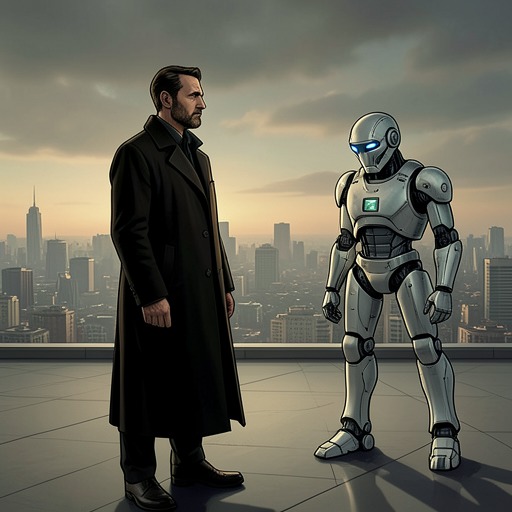
R. Daneel presents C/Fe as a direction Dr. Sarton had recognized as necessary. Sarton’s work on robots closely resembling humans was part of that broader conception. R. Daneel says that he was the first, and so far the only, robot of this design, made to resemble human beings closely enough to be accepted among them and observe their lives. His role joins the physical question of human–robot likeness to the cultural question of whether the two kinds of life could share a future.
The project is not presented as a claim that robots and humans are identical. R. Daneel distinguishes his own unusually human appearance, required by his function, from the different outward forms of other robots. C/Fe instead proposes combination without erasure: human and robot life remain distinct, yet neither is to possess priority in the culture they might make together. Baley, whose formal education has offered little about Outer World history and sociology, finds himself newly curious about what Spacer life is really like as this possibility comes into view.
Earth, Robots, and the Colonial Aim
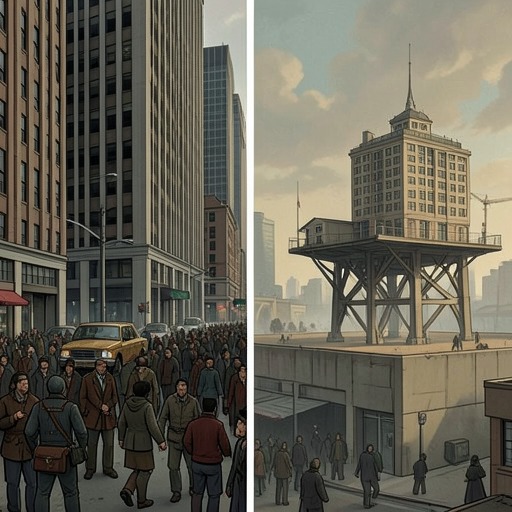
Dr. Fastolfe describes robot introduction on Earth as a deliberate attempt to unsettle the City economy. The resulting displacement is not, in his account, an end in itself: displaced and declassified people might become a nucleus for colonization because the City has failed to offer them a future and they have much to gain by leaving Earth. This strategy makes the human–robot conflict an economic and political problem as well as a matter of prejudice.
Fastolfe acknowledges that the effort is not working. Earthmen’s resentment of robots blocks the intended change, even though robots could accompany human settlers and ease the difficulties of adapting to a raw world, making colonization practical. C/Fe is therefore bound to a concrete tension: robots are proposed as partners in a new society, while their presence in Earth’s existing society intensifies opposition and displacement.
A New Strain of Human Society
Fastolfe distinguishes the proposed colonies from the Outer Worlds already established before Civism spread across Earth and before the Cities arose. The new settlements are to be founded by people carrying a City background together with the beginnings of C/Fe culture. He describes the result as a synthesis or crossbreeding, combining what he sees as the strengths of both cultural inheritances rather than simply reproducing the older Outer Worlds.
The projected future is deliberately comparative. Fastolfe believes Earth’s existing structure will decline in the nearer future and the Outer Worlds will degenerate more slowly at a later time; the new colonies, by contrast, might form a healthy new strain. Their effect could then flow back toward the older societies, including Earth, and help renew them. The proposal is a dream rather than an accomplished outcome, as Fastolfe himself concedes, but its significance lies in making colonization a reciprocal cultural possibility: a new society could be shaped by Earth and robot life, then in turn offer renewal to the worlds from which it came.